Back in April, reservations for a six-seat sushi counter tucked beside a new Latin restaurant in the Harlow District sold out within minutes of going live. A few blocks away on Sul Ross Street, the Menil Collection's little gray bookstore sat dark, its shelves boxed up for a renovation that will keep it running out of a temporary storefront for months. Both are signs of change in Montrose. Neither is moving at the same speed as the other, and that gap is the more interesting story.
Montrose gets described the same way in almost every guide: eclectic, artsy, full of restaurants and galleries. True enough, but it flattens something a longtime resident already senses without being able to name it. This neighborhood runs on two clocks. One belongs to the restaurant scene, where a single redeveloped block can go from empty lot to five open kitchens in under four years. The other belongs to the Menil, where a single building can sit closed for nearly a decade before anyone decides what comes next. Walking from one block to the other, you're not just changing scenery. You're changing timescales.
The fast clock: a city block turned into five restaurants
The clearest evidence sits at the corner of West Dallas and Peveto, where the Harlow District now operates on the footprint once occupied by Nino's, Vincent's, and Grappino di Nino, the trio of Italian restaurants the Mandola family ran for 45 years before closing them in August 2022. Since then, the block has filled in fast.
La Griglia, a Houston Italian institution for more than three decades, joined the Harlow District's tenant roster. Bari Hospitality Group, the team also behind Bari Ristorante and Georgia James, opened Katami in early April, a dinner spot pulling from Peruvian, Argentine, and coastal Spanish traditions, with brunch on weekends. Right beside it, chef Manabu Horiuchi, known around Houston as Chef Hori-San, opened Sushi Horiuchi with partners Yun Cheng and Ryan Snyder, a six-seat omakase bar built around sushi, wagyu, and sake. Pavón Coffee Den moved into 2,400 square feet of the same district as its newest coffee stop. An upscale cocktail concept is listed as coming soon.
That's five distinct food and beverage operators filling one block in under four years. Compare that to how long the same block sat as three restaurants under one family: 45 years without a single tenant change.
A few minutes east, the same fast clock is running inside the former Vibrant space at 1931 Fairview. James Beard Award winner Justin Yu, who won Best Chef: Southwest in 2016 for Oxheart, and his longtime business partner Bobby Heugel announced last fall that their group, Thorough Fare Hospitality, had purchased the property from Vibrant founder Kelly Barnhart. Thorough Fare already runs Anvil, Refuge, Better Luck Tomorrow, Catbirds, Blue Lagoon, and the Heights restaurant Squable. The still-unnamed Montrose project was penciled in for a spring 2026 opening, described only as an ambitious, full-service neighborhood restaurant. Vibrant's original Montrose café closed, though its second location at Memorial Park's Running Trails Center remains open and unaffected by the sale.
Two concepts, two operators, one shared trait: both moved from announcement to open doors, or close to it, in under a year.
The slow clock: a museum that measures change in decades
Now walk over to the Menil campus and the pace changes entirely.
The Menil Bookstore, one of the museum's historic gray bungalows facing the main building, closed on January 16 for a multi-year renovation. The project, led by KinneyMorrow Architecture, will expand the shop's interior, add back-of-house storage, and build a freestanding, air-conditioned public restroom. Until it reopens, the bookstore is operating out of a temporary space next door at 1524 Sul Ross Street. That's a modest, practical project, but it's already been treated as a multi-year undertaking rather than a weekend refresh.
The bigger example is the Fresco Building. From 1997 to around 2018, this space operated as the Byzantine Fresco Chapel Museum, built specifically to house two 13th-century frescoes that Dominique de Menil had restored after they were hacked out of a church near Lysi, Cyprus, and sold on the black market. The frescoes were always on loan. They were returned to the Church of Cyprus after March 2012, and the emptied chapel closed to the public in 2018. It has sat closed for nearly eight years.
This June, the Menil announced what comes next: the Fresco Building will reopen in late 2027 as a new home for site-specific commissions, timed to coincide with the museum's 40th anniversary. The inaugural installation belongs to Brooklyn-based artist Teresita Fernández. Museum director Rebecca Rainbow described the piece as one that "will join the Menil's other single-artist buildings, the Cy Twombly Gallery and the Dan Flavin Installation" at Richmond Hall. From closure to reopening, that's a project spanning roughly a decade, for a single room.
This isn't the Menil moving slowly by accident. It's closer to house style. The museum has grown the same way since its 1987 opening: a Drawing Institute here, a reopened chapel there, never an all-at-once renovation with a press conference and a new logo.
Why the same neighborhood runs two clocks at once
The pattern didn't start with the current bookstore project or the Fresco Building announcement. It goes back to how the Menil treated the neighborhood around it from the start.
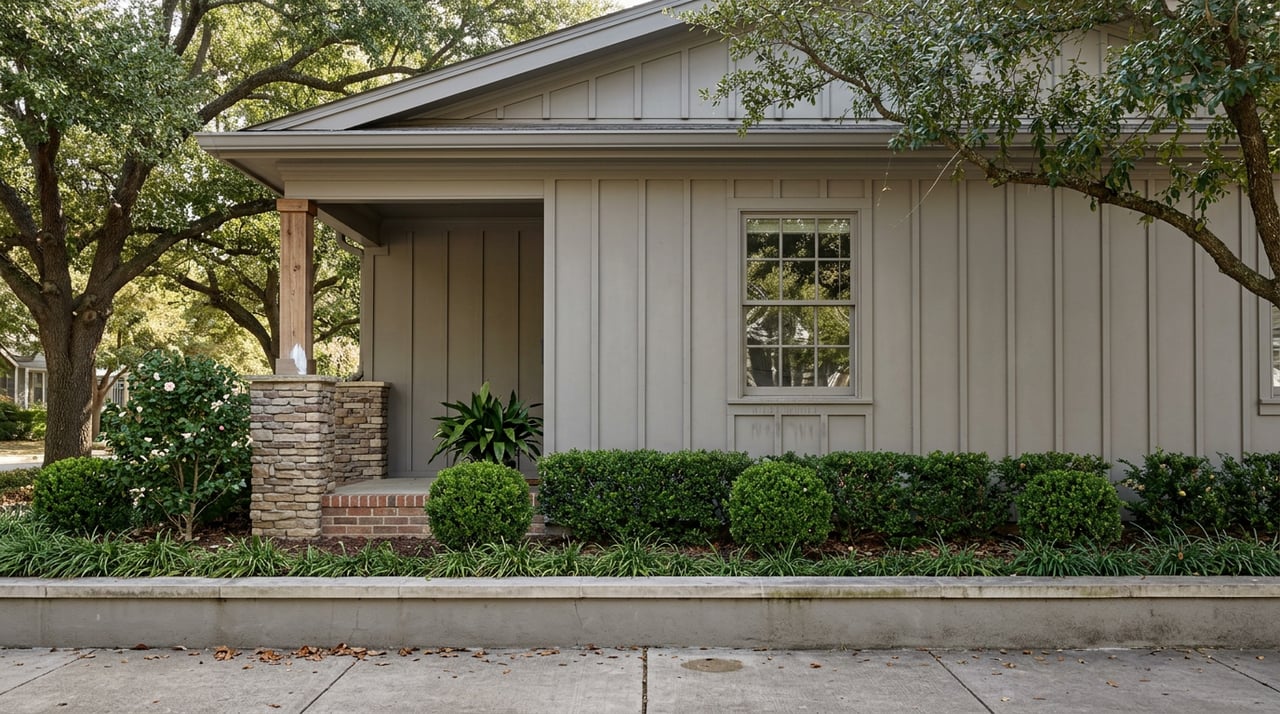
Beginning in the 1960s, John and Dominique de Menil, and later the Menil Foundation, began buying up small, single-family homes on the blocks surrounding what would become the museum campus. This wasn't a government land assembly. It was incremental, one bungalow at a time, over decades, with some houses used for administrative purposes and others rented out as affordable housing for artists. The result today is a pocket of Montrose where you notice what isn't there: no towers, no parking garages, just modest bungalows, "all painted the same soft gray, evenly spaced trees and quiet streets" that define the block as much as any gallery does.
That's the real contrast worth sitting with. A few blocks away, Montrose and neighboring Midtown have been reshaped by apartment complexes and mid-rise development, blocks that once held bungalows now holding hundreds of units. Around the Menil, that wave stopped decades ago because a couple of philanthropists with deep resources decided it should. The same neighborhood contains a block that turned over five times in under four years and a cluster of blocks that has barely turned over since the Johnson administration.
Neither clock is wrong. The Harlow District and the Fairview project are proof the neighborhood's food scene keeps regenerating without losing its independent, chef-driven character. The Menil's patience is proof that some things in Montrose were protected on purpose, not preserved by accident. What's useful for anyone living here is recognizing which clock you're standing next to before you assume the whole neighborhood moves at one speed.
What that means for your next few weekends
If you've been meaning to try Katami or grab a seat at Sushi Horiuchi, the fast clock argues for going soon. Concepts built around six-seat counters and buzzy debuts tend to get harder to book, not easier, once word spreads past opening month. The same logic applies to whatever ends up filling Justin Yu and Bobby Heugel's Fairview space once it opens.
If you're curious about the Fresco Building, the slow clock argues for the opposite: patience. Nothing there changes on a weekend timeline. The bookstore's temporary home on Sul Ross is worth a visit if you want art books and gifts this year, but the real payoff, Teresita Fernández's installation, won't arrive until late 2027. That's a fact worth knowing now, not because it changes this weekend, but because it changes how you plan a visit two years out.
Montrose isn't one story of change. It's two, running at different speeds a few blocks apart, and knowing which one you're watching tells you how soon to show up.
If you're weighing what a home in a neighborhood like this is actually worth, both right now and as these two blocks keep evolving on their own timelines, Nicole Calderon can walk you through it. Schedule a private consultation whenever the timing feels right.